
KYOKO DUFAUX
ARTIST STATEMENT
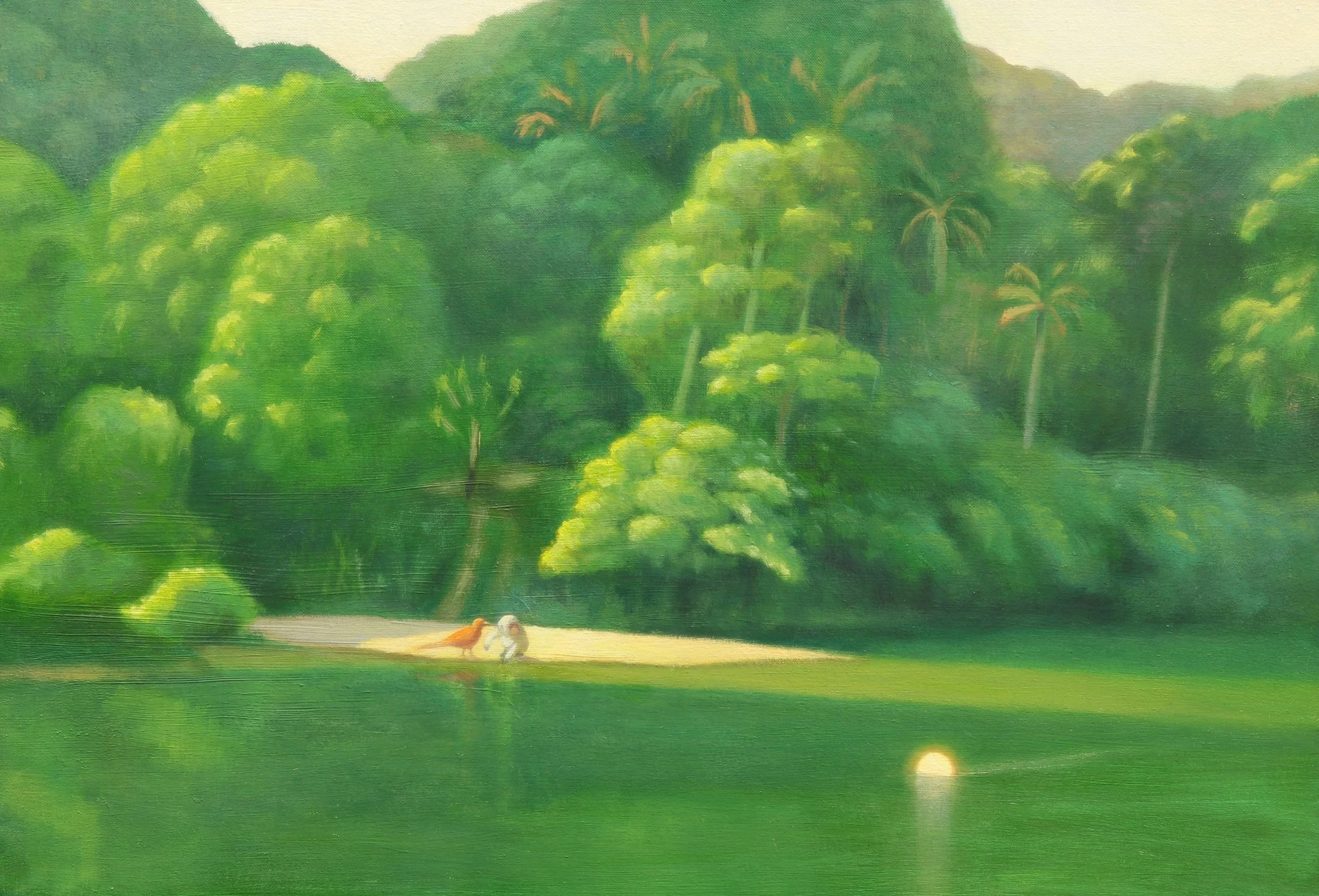
I am often asked why monkeys, birds, and dogs appear in my paintings.
This began in 2006, when I held a solo exhibition in Côte d'Ivoire themed on “Japanese folktales told within African landscapes.” I lived in Abidjan for six years due to my husband’s posting. At that time, people still washed clothes in the rivers running through the city. Having grown used to modern life in Japan, such scenes felt almost like a fairy tale—moments disconnected from the present. The daily landscapes in Africa, especially in the countryside, often looked like pages from a picture book.
The monkey, bird, and dog are the companions of Momotaro in the Japanese folktale. They join him on his journey to the island of demons, symbolising partners who transcend species to pursue a shared goal.
Though people long for peace, the world remains marked by violence. I believe that what truly heals and connects us—across age, culture, and history—is nature itself, and what I value most is an attentiveness to its subtle shifts, a sensibility cultivated through haiku. My creativity seeks no negation, no destruction, and conveys no irony; it is offered to each individual life within a vast, distant, mysterious, and suspended expanse. Beyond the simple yet overwhelming inspiration of Douanier Rousseau, my work also draws on the delicate transience found in traditional Japanese poetry, as well as on meditative concentration, which together lend it its more nuanced layers.
The choice of materials—oil paints or colored pencils—comes from my experiences creating work in various countries, including Mexico, Cambodia, Côte d'Ivoire, and Nigeria. These materials allow me to express myself anywhere; with only a pencil, a sketchbook, and candlelight, I can continue to draw. While modern technology can now achieve in an instant what once took our predecessors years to develop, it remains usable only under particular conditions. What appears to offer freedom ultimately imposes a fundamental constraint: dependence on electricity, which is, in truth, the opposite of liberation.